
Dual carriageways: joining, lanes and crossing
Joining from a slip road, keeping to the correct lane, overtaking, and when you can cross in two halves. Each step matches the numbers on the pictures, and there is a quiz at the end.
A dual carriageway has a central reservation between the two directions of traffic. Speeds are usually higher than in town, so look further ahead, check your mirrors more often, and leave bigger gaps.
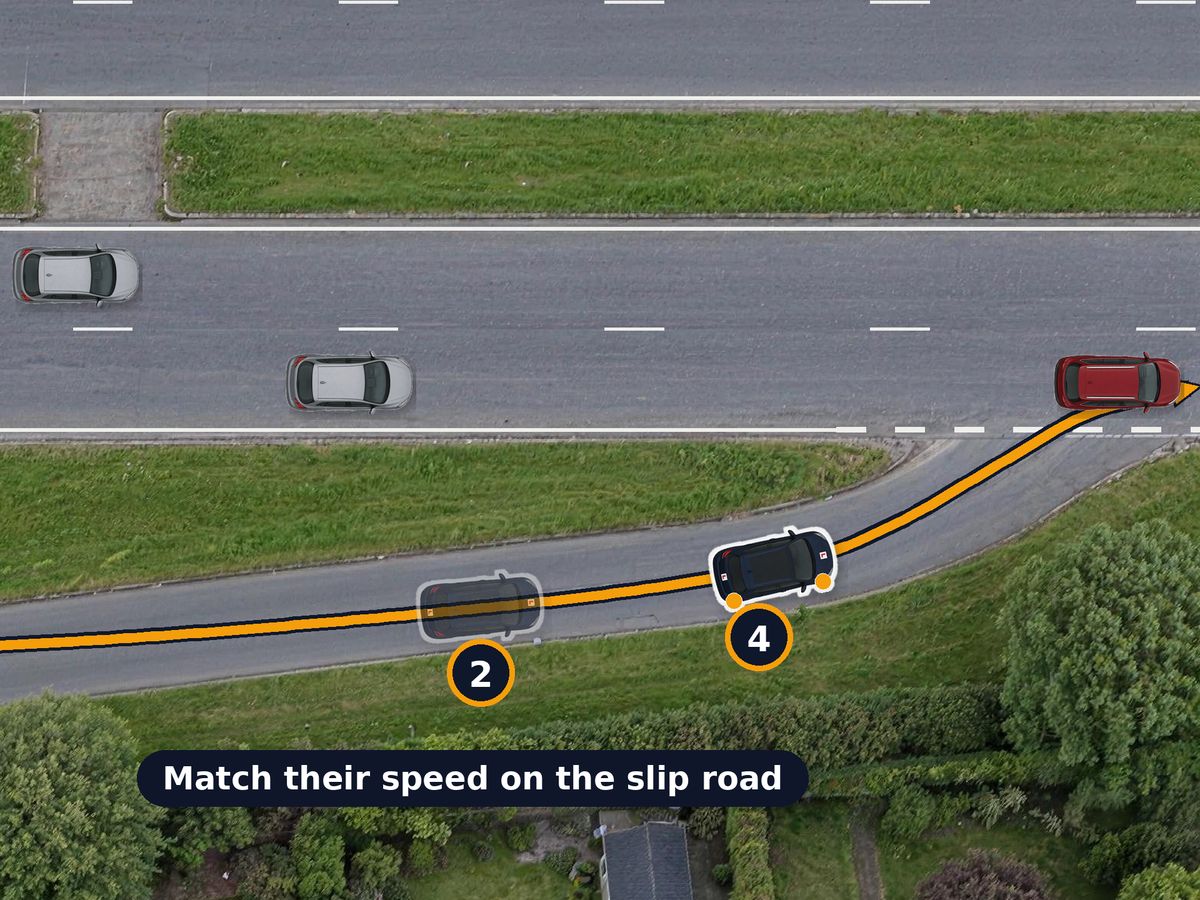
Joining from a slip road
Build up your speed on the slip road
The slip road is there to get you up to the speed of the traffic. Use it: joining slowly is what makes it hard.
Mirror and a look over your right shoulder
Find the gap you will join, early. The traffic already on the dual carriageway has priority.
Signal right, keep matching their speed
Adjust your speed to fit the gap, not the other way round. Do not expect anyone to move over for you.
Into the gap in the left-hand lane
Move across smoothly when it is clear. If the gap closes, slow down and take the next one, still on the slip road.
Settle in
Signal off, check your mirrors, and get a safe gap to the car in front.
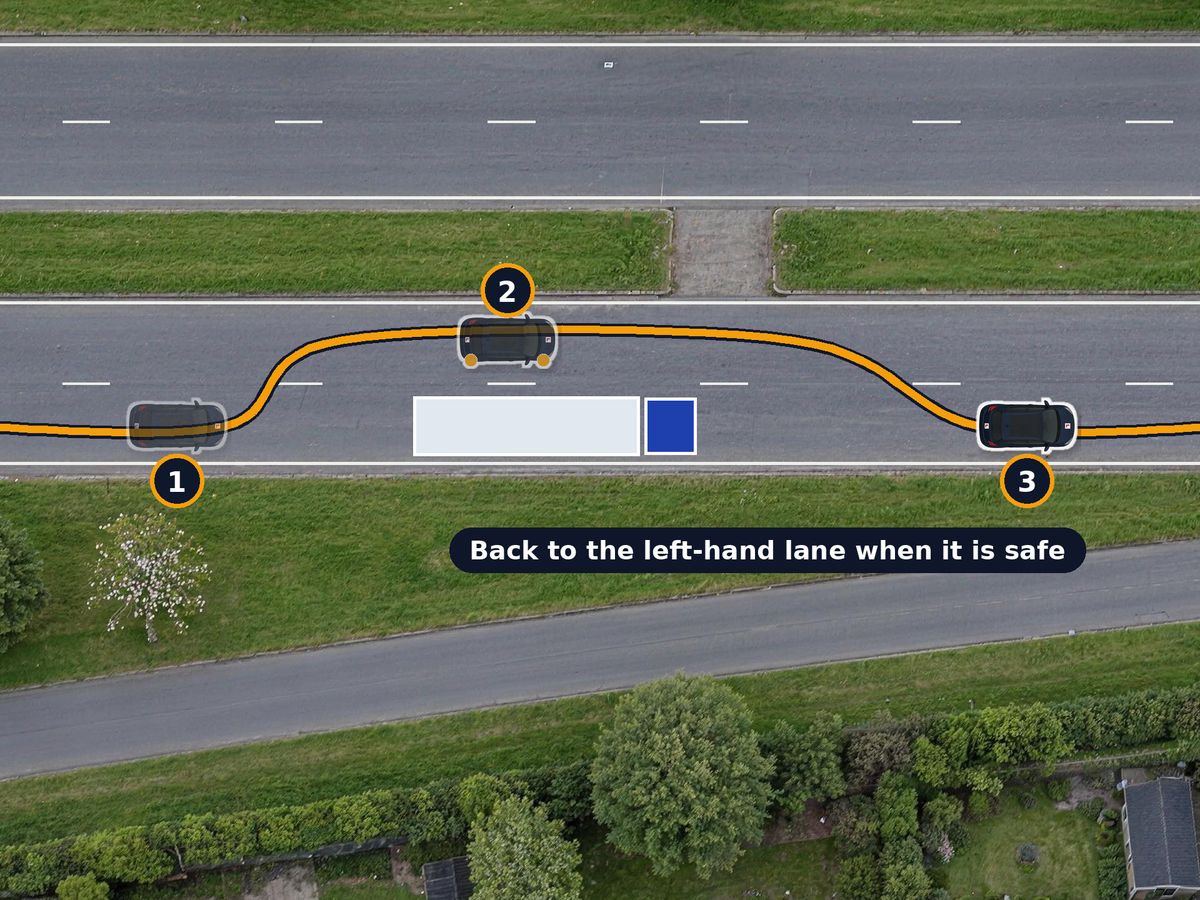
Lanes and overtaking
The Highway Code: On a two-lane dual carriageway you should stay in the left-hand lane.
Use the right-hand lane for overtaking or turning right.
After overtaking, move back to the left-hand lane when it is safe to do so.
- Before you pull out: mirrors, a glance into your right blind spot, then signal. Traffic in the right-hand lane may be closing fast.
- Pass and move back: once you can see the vehicle you passed in your interior mirror, it is usually safe to move back. Do not cut in.
- Three lanes: you
may use the middle lanes or the right-hand lane to overtake
, then return to the left. - Not on the left, unless traffic is queuing and the lane on your right is moving more slowly.
Crossing the central reservation
Crossing, or turning right through a gap in the central reservation, first ask one question: is the gap deep enough to hold your whole car?
- Deep enough: treat each half as a separate road. Cross to the middle when the first half is clear, and wait there for a gap in the second.
- Too shallow: your car would stick out into one carriageway or the other. Wait until both halves are clear and cross in one go.
On the road in the pictures the central reservation is about 4 metres deep, a little shorter than a small hatchback, so you would cross in one go.
Leaving
- Plan early: watch the signs for your exit and get into the left-hand lane in good time.
- Signal left before the slip road, and check your mirrors.
- Slow down on the slip road, not on the main carriageway, unless the traffic means you have to.
- Check your speed once you are off: after a fast road, slower speeds can feel slower than they are.
Dual carriageways quiz
Ready when you are
- 10 questions
- About 3 minutes
- Answers explained
- Nothing saved
Questions people ask
Which lane should you use on a dual carriageway?
The left-hand lane, normally. The Highway Code: On a two-lane dual carriageway you should stay in the left-hand lane.
Use the right-hand lane to overtake or turn right, then move back.
How do you join a dual carriageway from a slip road?
Use the slip road to build up to the speed of the traffic, check your mirror and over your right shoulder, signal, and move into a safe gap in the left-hand lane. The traffic already there has priority.
Can you cross a dual carriageway in two halves?
Only if the central reservation is deep enough to hold your whole car. If it is not, wait until both halves are clear and cross in one go.
Will I drive on a dual carriageway on my test?
Often, if there is one near the test centre, during independent driving or following the examiner's directions. Practise joining and leaving before your test.
Signed in
You are already on Driving Test Hero
Signed in as . Your test, your matches and your email settings are on My swaps.
Go to My swapsFree · about a minute
Not ready for your test date?
You do not have to sit it unready. Most learners want an earlier test, so someone at your centre may well want yours, and a swap gives you their later date with no new fee. DVSA does it over the phone. Ready sooner? It works the other way too. We email you when a learner who could swap with you joins, and your email is never shown to anyone.
Already signed up? Sign in
One email to confirm, no password, and one click takes you off the list. How we handle your details.
No test booked yet? There is nothing to swap until you have one. Book on GOV.UK, then come back.