
Emergency stop: react fast, brake firmly, stay in control
What the examiner does, how to brake hard without losing control, how far a car takes to stop, and how to move off again. Each step matches the numbers on the pictures, and there is a quiz at the end.
GOV.UK: You might also be asked to carry out an emergency stop.
DVSA's guidance for examiners: An emergency stop exercise should be conducted in 1 out of every 7 driving tests.
It is chosen at random, and it is the one thing on the test you might one day need for real.
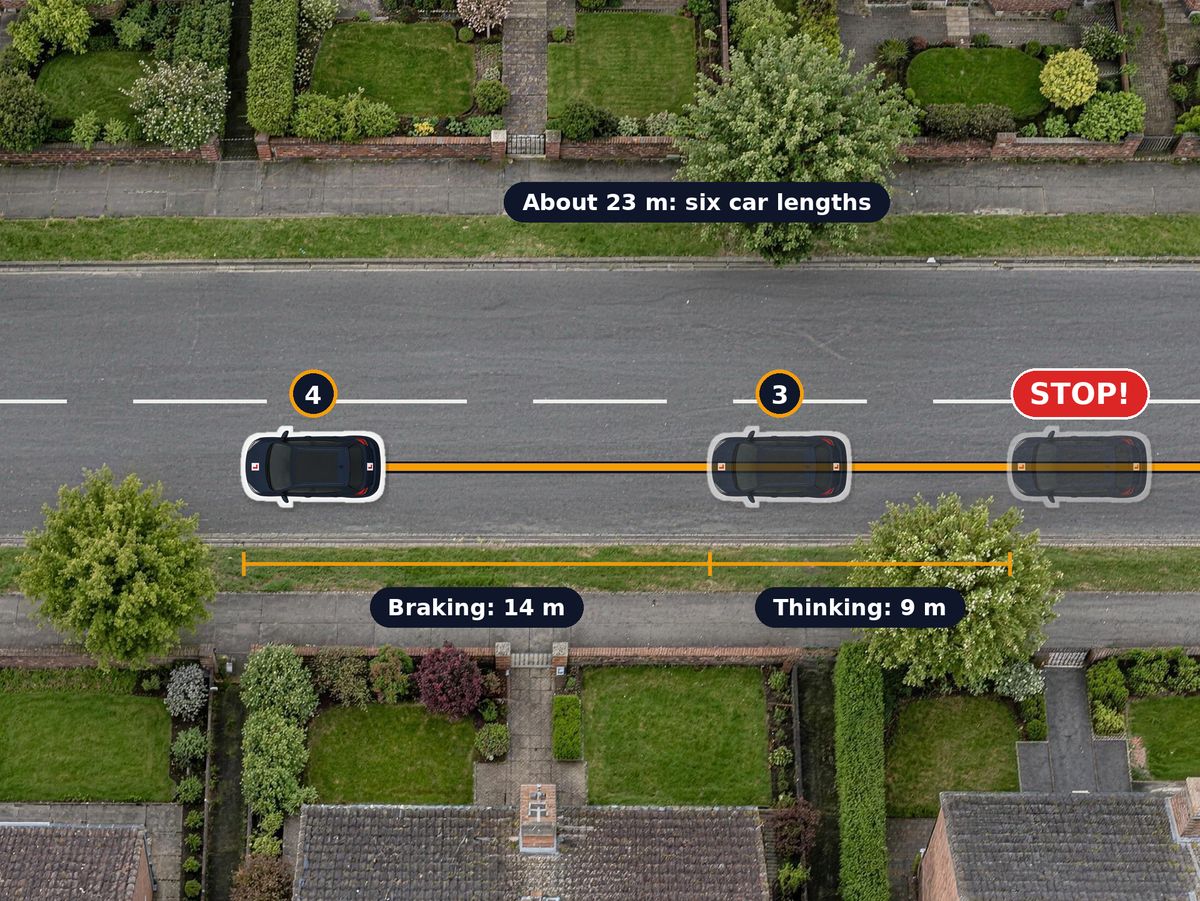
The emergency stop, step by step
Driving normally
The examiner pulls you over first and explains. They check it is clear behind before they give the signal, so drive on as usual.
"Stop!": react at once
The examiner raises a hand and says stop. Do not check your mirrors or signal: they have already looked. Move your right foot straight to the brake.
Brake firmly, both hands on the wheel
Press the brake hard and quickly, but progressively, not a stamp that locks the wheels. Keep both hands on the wheel and the car straight. Push the clutch down too, so you do not stall.
Stopped: secure the car
Handbrake on and neutral. If you stall, that is fine: secure the car and restart.
Look all round
You are stopped in the road, not at the kerb. Mirrors, then both blind spots: over your right shoulder and your left.
Move off when it is safe
When you are asked to drive on, go only when it is clear, signalling if it would help anyone, and carry on normally.
Brake, clutch and ABS
Both feet down
Right foot hard on the brake, left foot pushing the clutch down so you do not stall. With ABS you can press both together. Without ABS, brake first and press the clutch just before the car stops, so the engine helps slow you.
In an emergency
Brake immediately.
Try to avoid braking so harshly that you lock your wheels.
Locked wheels can lead to loss of control.
Rule 118.
With ABS
However, in the case of an emergency, apply the footbrake firmly;
do not release the pressure until the vehicle has slowed to the desired speed.
The pedal may judder: keep pressing. And do not assume that a vehicle with ABS will stop in a shorter distance.
Rule 120.
Stopping distances
Your overall stopping distance is the thinking distance, how far you travel before your foot reaches the brake, plus the braking distance. At the limit on most town roads, the Highway Code's typical figures are 9 m and 14 m: 23 m, about six car lengths, on a dry road. The picture above is drawn to those figures.
- Speed matters most. Thinking distance grows in step with speed, but braking distance grows much faster: double the speed and it is about four times as far.
- In the wet:
In wet weather, stopping distances will be at least double those required for stopping on dry roads
. Rule 227. - Tired, distracted or on your phone, your thinking distance gets longer before you even touch the brake.
- The rule of thumb:
Drive at a speed that will allow you to stop well within the distance you can see to be clear.
Rule 126.
Skids
Skidding is usually caused by the driver braking, accelerating or steering too harshly
or driving too fast for the road conditions.
If skidding occurs, remove the cause by releasing the brake pedal fully or easing off the accelerator.
Turn the steering wheel in the direction of the skid.
For example, if the rear of the vehicle skids to the right, steer immediately to the right to recover.
What the examiner marks
You were marked on how you reacted to the examiner's signal to stop and your control of the car while stopping.
You should have done this without locking the wheels and losing control of the car.
The most common faults are reacting too slowly when asked to stop
and locking the wheels causing a skid, particularly for cars without an anti-lock braking system (ABS)
.
Emergency stop quiz
Ready when you are
- 10 questions
- About 3 minutes
- Answers explained
- Nothing saved
Questions people ask
Will I have to do an emergency stop on my test?
Maybe. DVSA's guidance for examiners says it should be done in 1 out of every 7 tests, picked at random, so be ready for it.
Do I check my mirrors before an emergency stop?
No. The examiner checks it is safe behind before giving the signal, and in a real emergency there is no time. React and brake at once.
Do I press the clutch in an emergency stop?
Yes, push it down as you brake so the engine does not stall. With ABS you can press brake and clutch together; without ABS, brake first and press the clutch just before you stop.
What if I stall?
Secure the car with the handbrake and neutral, restart, and look all round before moving off. The examiner is marking how quickly you reacted and whether you stayed in control.
Signed in
You are already on Driving Test Hero
Signed in as . Your test, your matches and your email settings are on My swaps.
Go to My swapsFree · about a minute
Not ready for your test date?
You do not have to sit it unready. Most learners want an earlier test, so someone at your centre may well want yours, and a swap gives you their later date with no new fee. DVSA does it over the phone. Ready sooner? It works the other way too. We email you when a learner who could swap with you joins, and your email is never shown to anyone.
Already signed up? Sign in
One email to confirm, no password, and one click takes you off the list. How we handle your details.
No test booked yet? There is nothing to swap until you have one. Book on GOV.UK, then come back.