
Gears and steering: smooth control, every time
The gears and when to change them, steering with both hands, and the clutch control that ties it together. The picture shows the gear at each point, and there is a quiz at the end.
On the test the examiner watches your control all the way round: You needed to show you can use all the car's primary controls smoothly and at the correct time.
That means the accelerator, clutch, gears, brakes, handbrake and steering, working together. GOV.UK.
The gears
The pattern
Most manual cars have five or six gears and reverse. The lever sits in neutral, across the middle, when no gear is selected. Reverse is often beside fifth or first, sometimes behind a collar you lift: check your car.
What each gear is for
First: moving off and creeping. Second: most turns, slow traffic, and pulling away once rolling. Third and up: building speed and cruising, highest on open roads.
Changing gear
Clutch down fully and off the gas together, move the lever without forcing it, then clutch up smoothly as you press the gas again. Eyes on the road: the lever finds the gears by feel.
Your feet
Left foot for the clutch only. Right foot for the accelerator and the brake, pivoting on your heel. Never rest your foot on the clutch.
When to change
Change up as the car gains speed and the engine note rises. Change down when you have slowed for something, or to pull up a hill. See eco-safe driving for skipping gears.
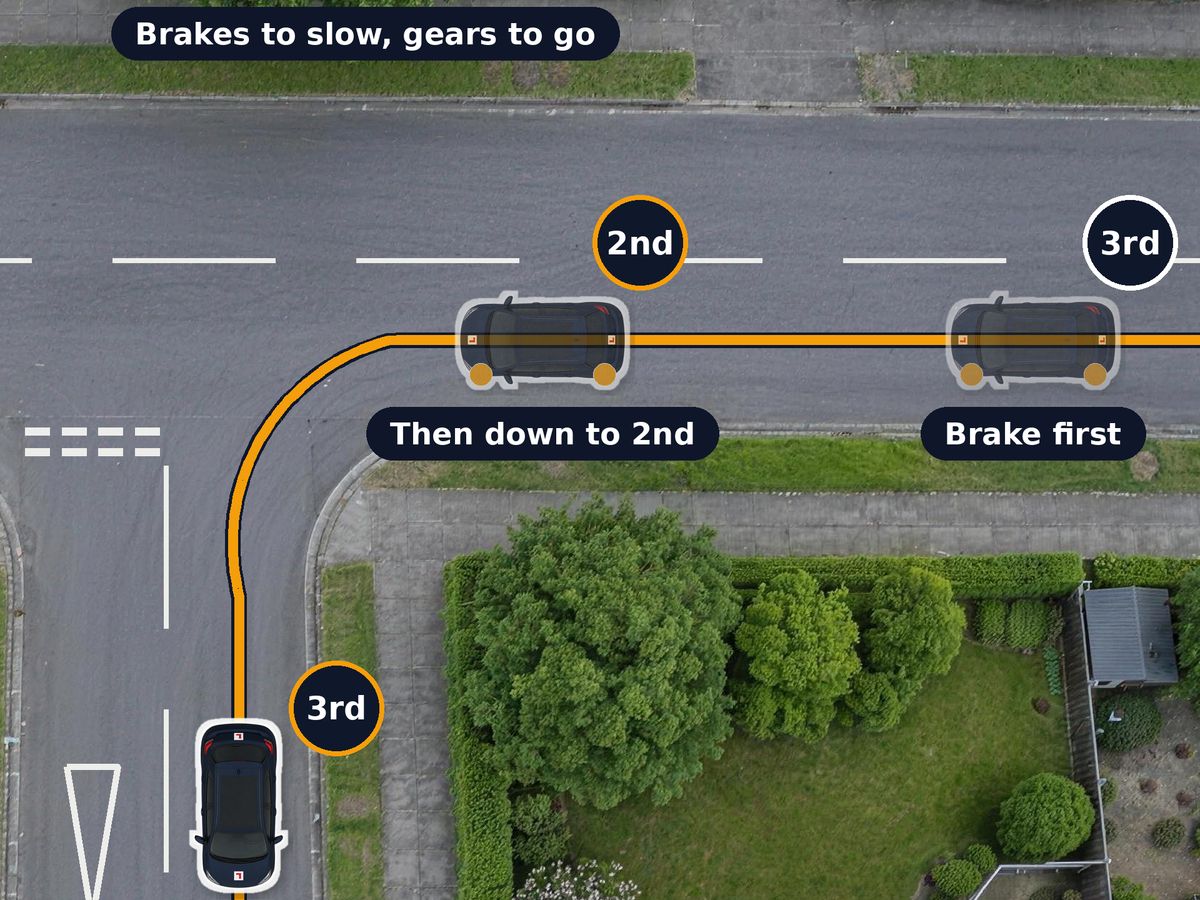
Brakes to slow, gears to go
In third at road speed
Mirrors, then signal left in good time.
Brake first
Slow down smoothly with the footbrake to the speed you want for the turn. Stay in third while you do: no need to go down through every gear.
Then the gear for that speed
Clutch down, select second, clutch up smoothly. The gear matches the speed you are now doing, ready to pull through the turn.
Turn in second
Both hands on the wheel, steering with pull-push. Look into the road you are turning into.
Speed up, change up
As the car picks up speed and the engine note rises, change up to third.
Steering
Pull-push
Turning left: slide your left hand up the wheel and pull down, while your right hand slides down and pushes up. Your hands never cross, and one always holds the wheel. Reverse it to turn right.
- Both hands, where possible. The Highway Code:
drive or ride with both hands on the wheel or handlebars where possible.
Rule 160. - Ten to two or quarter to three. Hands either side, thumbs along the rim, with a relaxed grip.
- Crossing your hands is not a fault in itself. Losing control is, which is why pull-push is taught.
- Feed the wheel back after a turn rather than letting it spin through your fingers.
- Look where you want to go. The car tends to follow your eyes.
Putting it together
- Clutch control. Holding the clutch around the biting point lets the car creep: the key to queues, junctions and manoeuvres.
- No coasting. Clutch down only to change gear or just before you stop. Otherwise you lose engine braking and control.
- Hills.
select a lower gear before you reach a long downhill slope. This will help to control your speed
. Rule 160. - One thing at a time. Finish braking before you change down; finish steering through a sharp turn before you change up.
Gears and steering quiz
Ready when you are
- 10 questions
- About 3 minutes
- Answers explained
- Nothing saved
Questions people ask
Can I skip gears when changing down?
Yes. Brake to the speed you want, then select the gear for that speed, such as fourth straight to second. It is smoother and wears the clutch less than going down through every gear.
Will I fail for crossing my hands?
Not in itself. Examiners mark whether you stay in control. Pull-push steering is taught because it keeps one hand on the wheel at all times and makes control easier.
How do I know when to change gear?
Listen to the engine and watch your speed. As you speed up and the engine note rises, change up; when you slow down for something, brake first, then choose the gear for your new speed.
What about automatic cars?
An automatic chooses the gears for you, so there is no clutch. Steering, braking and the rest are the same. A licence from a test in an automatic covers automatics only.
Signed in
You are already on Driving Test Hero
Signed in as . Your test, your matches and your email settings are on My swaps.
Go to My swapsFree · about a minute
Not ready for your test date?
You do not have to sit it unready. Most learners want an earlier test, so someone at your centre may well want yours, and a swap gives you their later date with no new fee. DVSA does it over the phone. Ready sooner? It works the other way too. We email you when a learner who could swap with you joins, and your email is never shown to anyone.
Already signed up? Sign in
One email to confirm, no password, and one click takes you off the list. How we handle your details.
No test booked yet? There is nothing to swap until you have one. Book on GOV.UK, then come back.