
Progressive and eco-safe driving: plan ahead, keep moving
Reading the road early, keeping a gap, using your gears well and going when it is safe to. Each step matches the numbers on the pictures, and there is a quiz at the end.
Progressive driving means keeping moving at a speed that suits the road, and going when it is safe. Eco-safe driving means planning ahead so you brake less, stop less and use less fuel. They work together: the driver who reads the road early is smoother, safer and cheaper to run.
What the examiner looks for
Progress: this counts
You should have driven at a speed appropriate for the road and traffic conditions, without holding up other road users.
Undue hesitation is marked too: you should not hesitate and slow down when you did not need to
.
Eco-safe: assessed, not scored
The examiner assessed your ability to drive with economy and the environment in mind throughout the test.
However, this assessment did not affect the overall result of the test.
You needed to:
plan well ahead to avoid unnecessary stopping
choose appropriate gears
avoid heavy braking
avoid over-revving the engine
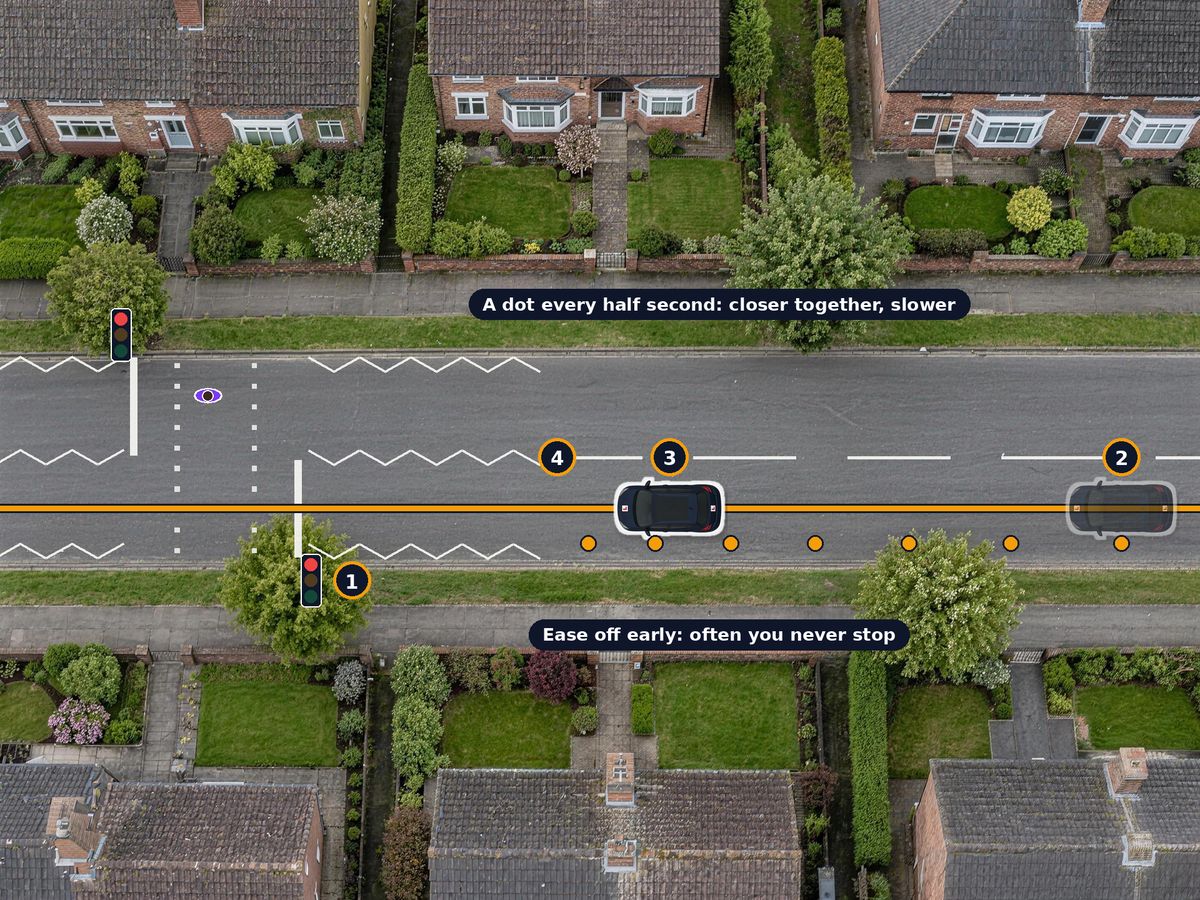
Plan ahead: ease off early
Spot it early
Look well ahead: lights, crossings, queues, junctions and bends. The sooner you see what is coming, the more time you have to deal with it.
Off the accelerator, still in gear
Lifting off in gear lets the engine slow the car for you, and a modern engine uses little or no fuel while it does.
Brake gently if you need to
Smooth, early braking, always ready to stop at the line if the lights stay red. Planning ahead never means rushing to beat the lights.
Still rolling when it changes
If the lights change before you get there, you carry on in a suitable gear without stopping and pulling away again.
Less braking, less fuel
Every stop and start burns fuel and wears the brakes. Reading the road early also gives you more time for hazards.
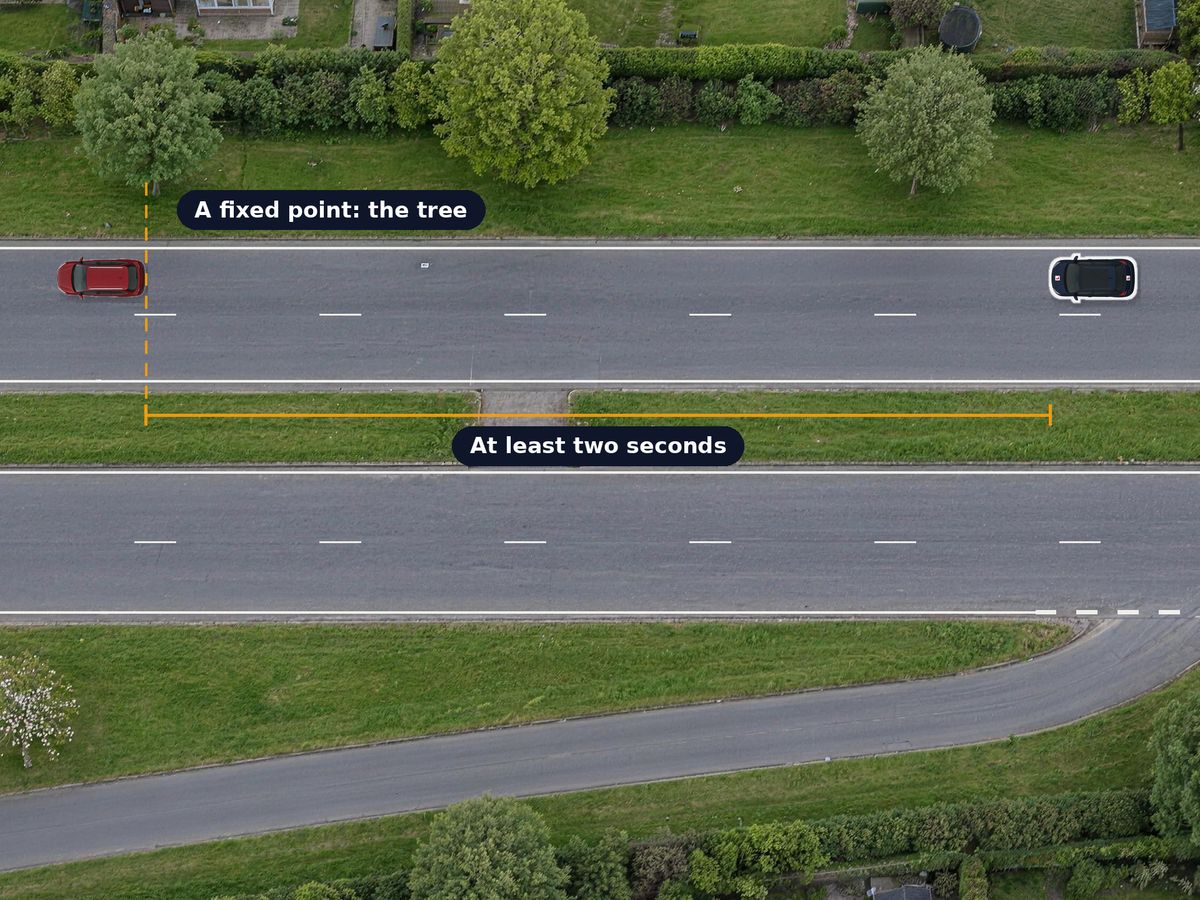
Keep a gap: the two-second rule
Pick a fixed point
A tree, a lamp post, a sign or a bridge, which the car ahead is about to pass.
Count as the car ahead passes it
Saying "only a fool breaks the two-second rule" at a normal pace takes about two seconds.
Reach it before you finish? Drop back
Ease off the accelerator rather than braking, and count again.
More in the wet, much more on ice
At least double the gap on wet roads, and allow up to ten times the gap on icy roads.
A good gap saves fuel as well as keeping you safe: when the car ahead slows, you can ease off rather than brake.
Accelerator, gears and coasting
Block changing
You do not have to go through every gear. Slowing right down from fifth, you can go straight to third, or to second for a sharp turn. Speeding up, you can skip one too. Fewer changes, smoother driving. Your car's pattern may differ.
- Accelerate smoothly. Harsh starts burn fuel for very little time saved.
- Change up in good time, without letting the engine labour. Revving hard in a low gear wastes fuel.
- Use engine braking. Lift off the accelerator in gear and let the engine slow you, then brake gently if you need more.
- Do not coast. Coasting means rolling along in neutral or with the clutch down. Keep the car in gear, and only press the clutch just before you stop or change gear.
Making progress
- A speed that suits the road. Up to the limit where it is safe, slower where it is busy, narrow or wet. Crawling well below a safe speed holds people up and invites risky overtakes.
- The limit is not a target.
The speed limit is the absolute maximum and does not mean it is safe to drive at that speed irrespective of conditions.
The Highway Code adds:do not treat speed limits as a target
. - Look early at junctions and roundabouts. If you have already seen that it is clear as you arrive, go. Stopping when it is safe and normal to go is undue hesitation.
- Join at the traffic's speed. On a slip road, build up your speed so you can fit into a gap. See dual carriageways.
- Be decisive, not hasty. When you have decided it is safe, commit to it. If you are not sure it is safe, wait: examiners would rather see that than a risky go.
Waiting, and before you set off
- Stopped for a while? At a level crossing, road works or a long hold-up, the Highway Code says
you should apply the parking brake and switch off the engine to reduce emissions and noise pollution.
Many cars do it for you with stop-start. - Never leave it running unattended.
You MUST NOT leave a parked vehicle unattended with the engine running
. - No need to warm up the engine standing still. Drive off gently instead.
- Tyres at the right pressure. Soft tyres use more fuel and wear faster. The pressures are in the handbook, and often on a label inside the door frame or fuel flap.
- Take off what you do not need: roof boxes, racks and heavy loads add drag and weight.
- Plan the journey so you are not lost or rushing. Air conditioning uses fuel too; use it when you need it.
Progress and eco-safe driving quiz
Ready when you are
- 10 questions
- About 3 minutes
- Answers explained
- Nothing saved
Questions people ask
Does eco-safe driving count on the driving test?
The examiner assesses it throughout the test and may talk to you about it at the end, but it does not affect the result. Progress does: driving too slowly for the conditions, or waiting when it is safe to go, can be marked as a fault.
What does progressive driving mean?
Making steady progress at a speed that suits the road and the traffic, without holding people up, and going when it is safe rather than hesitating. It is not about driving fast.
Is coasting allowed?
Coasting means rolling in neutral or with the clutch down. It is not illegal, but it removes engine braking and reduces your control, so stay in gear. Easing off the accelerator in gear is not coasting.
How long is a safe gap to the car in front?
At least two seconds in good conditions, at least double that in the wet, and up to ten times that on ice. Count from a fixed point as the car ahead passes it.
Signed in
You are already on Driving Test Hero
Signed in as . Your test, your matches and your email settings are on My swaps.
Go to My swapsFree · about a minute
Not ready for your test date?
You do not have to sit it unready. Most learners want an earlier test, so someone at your centre may well want yours, and a swap gives you their later date with no new fee. DVSA does it over the phone. Ready sooner? It works the other way too. We email you when a learner who could swap with you joins, and your email is never shown to anyone.
Already signed up? Sign in
One email to confirm, no password, and one click takes you off the list. How we handle your details.
No test booked yet? There is nothing to swap until you have one. Book on GOV.UK, then come back.