
Turn in the road: turning round safely in three moves
Choosing a safe place, the three moves, and the control and looking that make it work. Each step matches the numbers on the pictures, and there is a quiz at the end.
Since December 2017, The ‘reverse around a corner’ and ‘turn-in-the-road’ manoeuvres will no longer be tested
, but you should still be taught them by your instructor.
You will still need to turn round in real life, and it is the best practice there is for clutch control and slow, brisk steering. GOV.UK.
Where to do it
The Highway Code: Choose an appropriate place to manoeuvre.
If you need to turn your vehicle around, wait until you find a safe place.
Try not to reverse or turn round in a busy road; find a quiet side road or drive round a block of side streets.
Rule 200.
- Quiet, and wide enough. A residential road with little traffic.
- Clear of junctions, bends and the brow of a hill, where others cannot see you in time.
- No parked cars on either side where you will turn, and no lamp posts or trees right at the kerb edge.
- Somewhere legal, not on zig-zags or across a driveway someone is using.
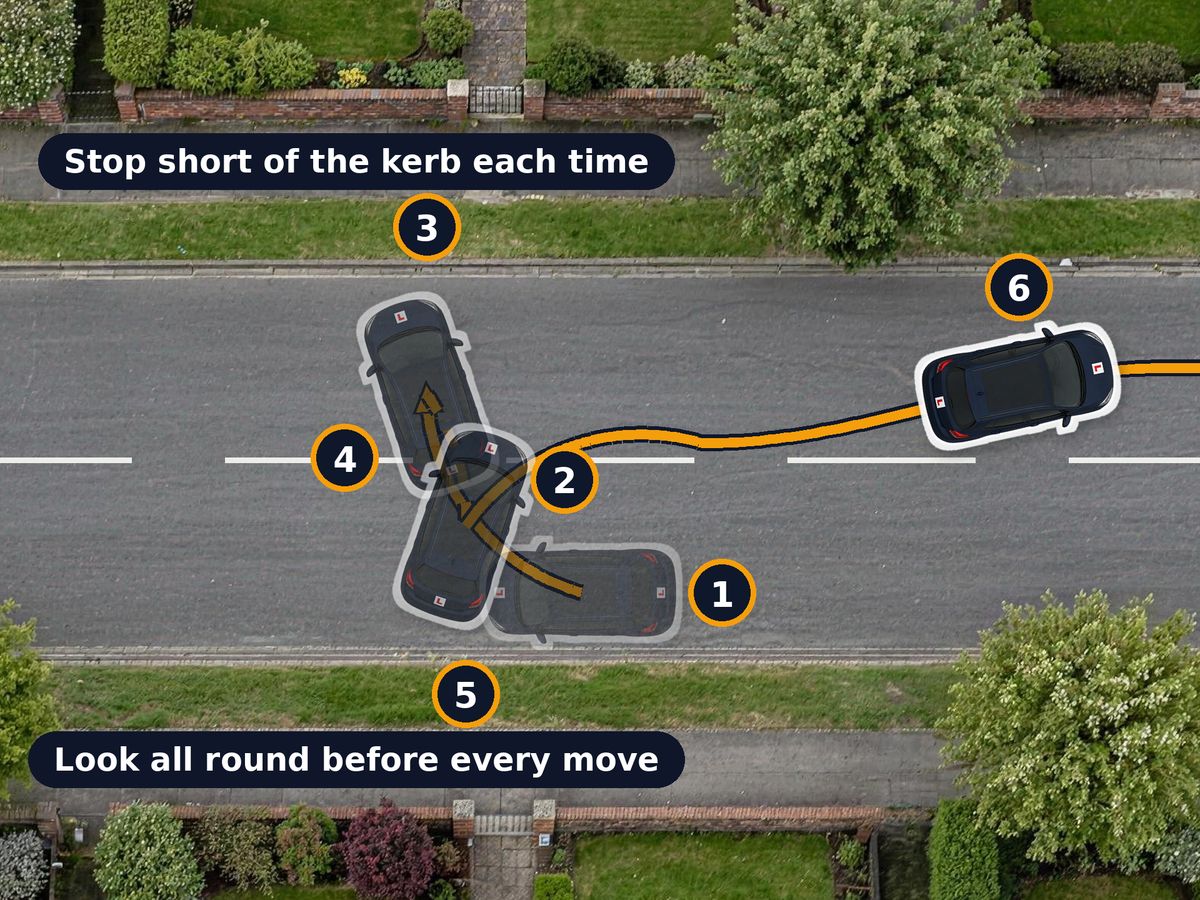
The three moves
Pull up on the left, then look
Somewhere quiet and safe. Mirrors, then all round, both blind spots. Only start when nothing is coming either way.
Forward on full right lock
Clutch control at a crawl, and steer briskly to full right lock as you start to move. In the last metre before the far kerb, steer briskly back to the left, then stop short of the kerb.
Stopped: look all round
Handbrake on if the road slopes. Look right, left, and behind: you are across the whole road, so traffic from either side matters.
Back on full left lock
Reverse slowly, steering briskly to full left lock, looking mainly out of the back window, over your left shoulder. Glance to the front and right too: the front of the car swings out.
Stopped short of the kerb: look again
In the last metre, steer briskly right, then stop before the back of the car reaches the kerb. Look all round once more.
Forward, straighten up, drive on
Clear both ways? Forward on right lock until you face along the road, straighten up, and move to the normal position on the left.
Control
- Slow speed, brisk steering. Keep the car at a crawl with the clutch at the biting point, and turn the wheel quickly.
- Steer while moving. Turning the wheel while stopped, called dry steering, scrubs the tyres and strains the steering.
- Set up the next move early. In the last metre of each move, steer briskly the other way, so the wheels are ready.
- Watch the slope. Roads are usually higher in the middle, so near each kerb the car may want to roll. Be ready on the brakes.
- Stop short of the kerb. The bonnet and boot hide it at the end, so stop a little early. Touching it can damage tyres and wheels.
Reversing safely
The Highway Code on reversing: Look carefully before you start reversing.
You should use all your mirrors
, reverse slowly while checking all around
, looking mainly through the rear window
and being aware that the front of your vehicle will swing out as you turn
. Get someone to guide you if you cannot see clearly.
Rule 202.
If anyone comes along while you are part-way through, stop and see what they do. If they wait for you, carry on with care; if they want to come through, let them. No signals: they would only confuse.
Turn in the road quiz
Ready when you are
- 10 questions
- About 3 minutes
- Answers explained
- Nothing saved
Questions people ask
Is the turn in the road on the driving test?
No. It was taken out on 4 December 2017, along with reversing round a corner. GOV.UK says you should still be taught both by your instructor, because you will need to turn round in real life.
Does it have to be three moves?
No. It is often called a three-point turn, but on a narrow road five moves is fine. What matters is control, not touching the kerbs, and looking all round.
Do I signal in a turn in the road?
No. A signal could confuse other road users. Look all round before every move, and let anyone who comes along go first if they want to.
What is dry steering?
Turning the wheel while the car is not moving. It scrubs the tyres and strains the steering, so most instructors teach you to steer while the car creeps, however slowly.
Signed in
You are already on Driving Test Hero
Signed in as . Your test, your matches and your email settings are on My swaps.
Go to My swapsFree · about a minute
Not ready for your test date?
You do not have to sit it unready. Most learners want an earlier test, so someone at your centre may well want yours, and a swap gives you their later date with no new fee. DVSA does it over the phone. Ready sooner? It works the other way too. We email you when a learner who could swap with you joins, and your email is never shown to anyone.
Already signed up? Sign in
One email to confirm, no password, and one click takes you off the list. How we handle your details.
No test booked yet? There is nothing to swap until you have one. Book on GOV.UK, then come back.